
The construction industry is one of the largest producers of greenhouse-gas emissions. Rising energy prices, legislative pressure and investor demands for sustainability have made carbon management a key competitive advantage. Today, carbon footprints already influence access to financing, success in public procurement and insurance conditions. A new emissions-management handbook has been developed in response to the need to prepare the construction sector for a future in which transparent emissions data determines competitiveness.
What Is a Carbon Footprint and Why Is It Important to Measure It?
A carbon footprint represents the total volume of greenhouse-gas emissions associated with all of a company‘s activities: from the production of building materials, through transport and construction itself, to the long-term operation and eventual demolition of buildings.
Precise calculations show how much greenhouse-gas emissions, expressed as CO₂ equivalents, are generated by energy consumption, the operation of construction machinery, or the transport of materials. Quantifying the carbon footprint provides a strategic basis for:
- Reducing operating costs through energy savings.
- Complying with legislative requirements and avoiding penalties.
- Gaining the trust of investors focused on ESG criteria.
- Achieving a competitive advantage when bidding for green contracts.
- Ensuring long-term business sustainability in a changing regulatory environment.
What Steps Does Carbon Management Involve?
Effective carbon management is a systematic, long-term process involving five key stages:
- Calculating emissions using recognised international methodologies, such as the GHG Protocol or ISO 14064, to ensure data credibility and comparability.
- Analysing the main sources of emissions and identifying the greatest opportunities for savings across company activities.
- Setting specific, measurable targets for reducing emissions.
- Implementing effective measures to achieve energy savings, selecting low-emission materials, optimising logistics and taking other practical steps.
- Continuously monitoring, evaluating and adjusting the strategy based on results achieved.
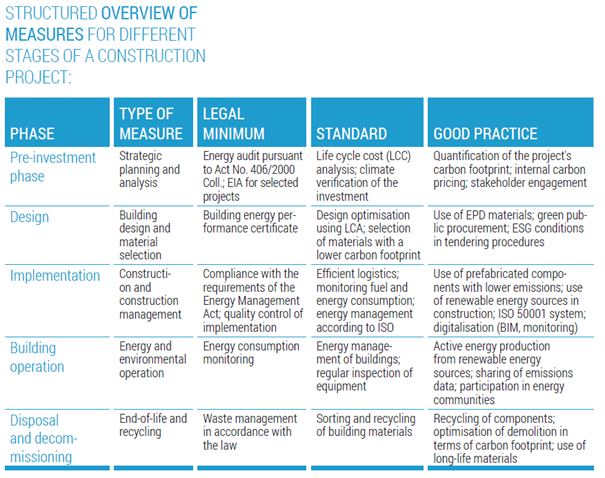
The table provides a structured overview of measures for different stages of a construction project.
What Role Does the Handbook Play in Implementing Carbon Management?
The handbook is being developed as a practical tool to help businesses navigate ESG requirements and to offer specific recommendations for small and large enterprises. It includes a methodology for measuring emissions throughout the entire life cycle of buildings, guidelines for setting realistic targets, and an overview of measures based on ambition level — from the legal minimum to best practice. Emphasis is placed on collaboration throughout the value chain and on using data to design and deliver sustainable projects.
Effective carbon footprint management is becoming essential for ensuring the long-term prosperity of companies in an evolving market environment.
Jiří Karásek, Michael Baraník jiri.karasek @ svn.cz
